February 24, 2007

Back to the Pad

I was sitting at my desk Wednesday morning when the phone rang. It was a guy I know who works for the Space Station group.

"So what're you doing this afternoon?"
"Have a couple meetings, why?"
"I was going to head over to the pad..."
"Hmm. I might be able to get out of them. Let me check and call you back?"
"Okay, sure."

A few minutes later I called him back.

"Alright, they'll let me go."
"Cool, pick you up at 1?"
"Awesome."

I didn't have to look for my field trip with Myca this week. It found me. Pad 39-A it was.

There are a number of things out at the pad necessary to launch the shuttle, the most obvious being the metal structure that sits on top of it. This has two basic parts. The tall straight one is called the Fixed Service Structure, or FSS, and the shorter wide part is the Rotating Service Structure (RSS).

All of the platforms and pieces that attach to the shuttle are connected to the FSS. The two elevators in it only go to the 255 ft. level, but there are stairs we can take to get all the way to the top. The long white thing that sticks up is part of our Lightning Supression System. This is very important because KSC is in the lightning capital of the United States and if lighting strikes we don't want it to hit our vehicle. The last time this happened was when Atlantis flew for STS-115 in September 2006. Thankfully our lighting rod worked.

Photo: NASA
The RSS is the part we saw moving last week. It has platforms that let us do work on the orbiter and holds the Payload Changeout Room (PCR). "Payload" is the word we use for anything other than the vehicle or the astronauts that we are launching into space. It could be a satellite, a container of supplies or, like this mission, a piece of the International Space Station. (ISS).

Part of the PCR is what we call a cleanroom, which means we control the air and particles inside of it. I had to wear a bunny suit and stand in an air shower (a little room that blasted me with air to blow any dust away) before I could go in. Unfortunately they didn't have a bunny suit that could fit Myca, so she had to wait outside.

Photo: Jeremy P.
The payload going up in March is the S3/S4 truss segment. These are the pieces with solar panels that help power the space station. The panels are folded up inside the two long gold boxes. After the truss is attached to the space station they will come down 90 degrees to make a straight line with the circle in the middle and will then stretch out to unfold the panels. I recommend watching NASA TV on Flight Day 5; seeing it happen is better than any description I could give.

One of the things I love about going to the pad is the view. The day we went out was beautiful and you could see pad 39-B clearly against the blue sky.

I do not recommend a trip up there to anybody who doesn't like heights. Not only are you over 250ft. off the ground, but what you stand on is not solid. Every floor at the pad is more like walking on a giant sewer grate and you can see straight through to the ground. I am over 100 ft. higher than the cars in this picture, and what you can't see is the flame trench (big hole for the flames at launch) that I am directly over.

You can also look up and see any people at every level above you.

If there is one place everybody visiting the pad for the first time wants to peek at, it's the white room. This is where the astronauts get into the shuttle before launch. It's not very large, and is more like a box leaning against the shuttle that is connected to the pad by a long walkway.

At the same level as the white room we have slide wire baskets. If something goes wrong and the astronauts have to get away from the shuttle quickly they get in the baskets and fly down the wire to a place where they can be safe.


The best part of the visit came when I took Myca to see the white room for the first time. Here we are before going down the walkway:

Photo: Jeremy P.
There's not much to see in the white room other than the hole you crawl through to get into the shuttle. The only way to tell which vehicle you're looking into is the covering that says "Atlantis" on the open door. If I remember correctly the yellow tubing carries air into the orbiter. There's somebody in the white room at all times who controls who and what goes in and out of the vehicle. She said we could go up to the door and take a picture.

Photo: Jeremy P.
This is where it got interesting. One of the guys inside the shuttle poked his head out and asked if Myca was Flat Stanley. I told him it was something like that, but not quite; the the astronaut was getting a tour for my cousin up in New York. He then asked the woman monitoring the white room for permission to bring Myca and my camera inside. I was ecstatic. She was about to experience something many people working at the space center never get to.

This week Myca didn't just go inside her first space shuttle, she went into the one at the pad waiting to launch. And where did they take her picture? The seat Commander Rick Sturckow will sit in as his crew blasts off on the STS-117 mission. How cool is that?

Photo: 1st shift SCO, Feb-21-07
Thanks this week go to Jeremy for inviting me out and taking pictures, Mike and Matt for putting up with me being a tourist, Tony for his help with the basket pictures, Mike, Scott and Bob for letting me out of their meetings, and two wonderful people in the white room whose names I forgot to ask for in the middle of my excitement. This is going to be a hard week to top.

February 17, 2007

Atlantis on the Move, Take 2!

After the excitement last week Atlantis spent 8 days in the Vehicle Assembly Building (VAB) getting connected to the other shuttle pieces. Thursday morning it was time for another big event: rollout to the launch pad. All of our launches now will be from Pad 39-A, which means the shuttle has to be moved about 3.4 miles. The hazy picture below is from the roof of the VAB. It shows the pad and the road the shuttle takes to get to it.

Photo: Sam M.
Rollout takes a long time because we only move the shuttle at around 1 mile per hour. If you started riding your bike at First Motion (the time the shuttle begins moving) you would probably get to the pad first and still have to wait a while for it catch up. Since it goes so slow Myca and I took our time getting out there to see it.

We drove out half an hour after first motion. The shuttle had moved far enough away from the VAB that you could see it clearly from up the road several miles away.

A few minutes later we were in the VAB parking lot as the shuttle looked like it was sitting between some trees. We took a picture and walked closer to find a crowd of other people who had come out to watch.

We also walked around a little to find other views of the shuttle in motion.


The "road" the shuttle takes to the pad is called the Crawlerway. The rocks covering it get crushed under the weight of the vehicle and its carrier as they move down it. I can't imagine 20 million pounds well enough to come up with a good comparison, but one thing I know for sure is that I wouldn't want to be one of those rocks. In this picture you can see the difference between the ones it ran over and the ones it didn't as it came out of the VAB.

Myca and I then went across the street toward the Kennedy Space Center Press site. On the way we passed the ET boat.

The Press site is what you see on TV a lot because it's where the big countdown clock is. The clock is off because we're not close enough to launch right now, but it should light up again 3-4 days before liftoff.


Atlantis took around 7 hours to get to the launch pad. After it arrived Myca and I went out with one of my coworkers for a look.
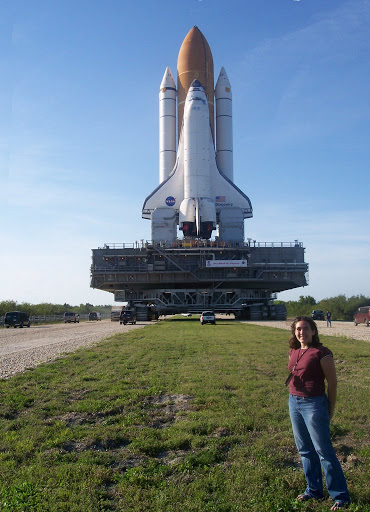


The big grey thing on the left side is the Rotating Service Structure, or RSS. It covers the shuttle while it's on the pad before launch. The few hours we were there are the only time the shuttle can be seen like this until they move the RSS again before launch.


We stayed out until it got dark and watched as they moved the RSS over the shuttle. It was awesome to see it all lit up like that.

I'll do a better walk around of the pad another week, but I wanted to put up some good pictures of Myca with the whole shuttle out there. Thanks this week go to Tony for walking around with me, and for his help with some of the pictures. Saturday seems to be my update day, so I'll be back next weekend with more pictures as Myca and I explore the Kennedy Space Center. See you then!

February 9, 2007

Atlantis on the Move!

One of the major events that takes place before a launch is called rollover. This is when the orbiter flying the next mission is moved from its home in the Orbiter Processing Facility (OPF) to the Vehicle Assembly Building (VAB). Inside the VAB the orbiter is picked up and attached to the other shuttle pieces before being moved to the launch pad.

Rollover of Atlantis for the March launch was this week and Emma's Astronaut was there. We met a friend of mine at Kennedy Space Center around 5:45 on Wednesday morning to go watch together. First Motion – the time when the vehicle begins moving – was scheduled for 6am. It was still dark, it was cold for Florida, and there were very few people around.

This is a shot of Atlantis inside the OPF before it began moving. The three large red circles are covers for the engines. I tried to get a picture of the astronaut with this in the background, but it was still too dark.

NASA's website says that first motion wasn't until 6:19am. Within half an hour the sun was rising,

and Atlantis was out of the OPF.


We watched the rollover from the side of the road Atlantis had to travel between the OPF and VAB. After they backed it out, they drove it right past us.

Photo: Mike G.


During all of this many people saw Emma's astronaut and asked me what I was doing. Everybody I explained the project to thought it was a great idea and several offered to help. One also asked if she had a name. I've decided to call her Myca, which is short for “My Cousin's Astronaut". NASA uses a lot of acronyms. Sooner or later I was going to be infected too.

Unfortunately Atlantis didn't stop moving just because I stopped to talk, so I missed the rest of the rollover. My friend Mike followed it without me and got a great picture of Atlantis outside of the VAB.

Photo: Mike G.
Later that night I took Myca back to the VAB to see Atlantis waiting for lift. This is when we pick up the orbiter, flip it, and lift it into place to be connected to the other pieces of the shuttle. Mike came with me again and we got there just as they finished flipping Atlantis to the vertical position.

Photo: Mike G.

Next we went up to the 5th floor to get a little closer.

Photo: Mike G.

Photo: Mike G.
Then we waited a few hours for the lift to start. During that time we went back to the External Tank (ET) holding cells to look at the pieces it would be attached to. The orange part is the same ET from the first stop. The two white pieces are the solid rocket boosters, or SRBs. When put together like this we call the whole thing the stack. The large concrete strip running through the middle of the picture is the walkway the orbiter has to be lifted over before it can get attached. I would guess it's between 150 and 200 ft. high.

There wasn't much light where we were, so I couldn't get a good picture of Myca with the stack in the background. I was also afraid of dropping her from 267ft. up. I decided it was better to leave her someplace safe before we went back up for the lift. While I was doing that, Mike was on the ground floor as they started to raise Atlantis.

Photo: Mike G.
We rushed back to the elevator to get on the ET holding cells and watched Atlantis slowly rise up in front of us. It was an amazing sight.


After the orbiter is raised it is moved over the stack. At this point it is still at an angle, and must be twisted so it fits right when it is lowered.

This is where the orbiter stopped before I left. After 18 hours at the space center I was very tired and ready to go home.

Thanks this week go to Mike for his help with the pictures, to Bill for getting us back to the ET cells, and to Lyle and Christy for talking with us as we waited for the lift. It was a long day, but it was definitely worth it.

Atlantis is now attached to the stack and being worked on before rollout next week. I don't know when that is scheduled for, but I plan to have Myca there as well.

February 1, 2007

A Time to Remember

Of all the places I want to take Emma's Astronaut, today's stop is probably the most accessible to the general public. Some would say it's also the most important.

Though exciting, adventurous and inspiring, space flight is not easy. Sometimes things go wrong and, sadly, sometimes people die because they did. Historically this is a tough week for NASA. On January 27, 1967 we lost three astronauts in the Apollo 1 fire. On January 28, 1986 we lost seven more when Challenger exploded just over a minute after launch. On February 1, 2003 - exactly 4 years ago today - we lost another seven when Columbia disintegrated on its way home to the Kennedy Space Center.

The Visitor's Complex at KSC is home to a memorial for all 17 of those astronauts, and for others who lost their lives serving the US space program. It's not a happy stop, but I could think of no other that was more appropriate this week. I ignored the rain that started as I left work this afternoon and went anyway.

The Space Mirror Memorial faces the road, so you actually approach it from behind.


The lights on the back make it look like the names carved into the front of the wall are glowing. The last time I had seen the memorial it was full of people there for a ceremony, but today it was empty, wet, and a little cold.


The group of names at the top of the picture are for the STS-107 Columbia Astronauts. The other large group is for the STS-51-L Challenger crew, and the smaller one near the signs is for Apollo 1. The signs and wreaths were placed next to the wall on the anniversaries of Columbia and Apollo.


And here's Emma's astronaut a bit wet from the rain. I would have preferred she didn't cover up so much of the wall, but it was the best I could do being out there by myself.


Some people say that we shouldn't explore space because it's too dangerous. The men and women listed on this wall disagreed. They didn't just believe exploring space was worth risking a human life, they believed it enough to risk their own. How many of us can say that about anything we do?

Thanks today go to a Visitor's Complex employee named Beverly, who was kind enough to give me a plastic bag to protect Emma's Astronaut from getting wetter as I walked to my car.

Thanks also go to Stephen the security guard. When I got to the Visitor's Complex the ticket booths were closed and the entry doors were locked, so I snuck in through the exit door where he was standing. I showed him my badge and told him I just wanted to stop at the wall for a minute if he'd let me. He didn't remember who I was when I thanked him as I left, but today's visit would not have been possible without him.
 
This site is not affiliated with or endorsed by NASA.
Any opinions expressed are those of the author and are not representative of the agency.
All text and images property of Bec unless otherwise stated.